Consistency is less about discipline than about design. The creators who keep showing up week after week have usually shaped their work so that showing up is easy, even in a hard week. If you are looking for tips for creating content consistently that respect a full life, including children, a household and a business to run, these are the habits worth building. None of them asks you to do more. Most ask you to decide once and repeat.
Tips for creating content consistently start with a realistic pace
The most common reason content stops is a pace that was never sustainable. A burst of daily posting feels productive for two weeks, then a sick child or a busy client month arrives and everything halts. Set your pace by your hardest month, not your best one.
- Count your real hours. Look at last month and note how much time you truly had for content, not how much you hoped for.
- Choose a cadence that fits those hours. For many people that is one main piece and one or two smaller ones a week.
- Commit for a season. Keep the same pace for at least three months before deciding to increase it.
A modest pace kept for a year builds far more than an ambitious one kept for a month. The longer argument for this is in Do More Isn’t a Strategy.
Choose content pillars so ideas are never a daily decision
Deciding what to make is often harder than making it. Content pillars remove that decision. They are three or four broad themes your brand returns to, each connected to what your audience cares about and what you offer.
For a home and family lifestyle brand, pillars might be:
- Home: styling, small spaces, seasonal changes.
- Routines: mornings, weekly resets, meal planning.
- Work from home: desk setups, planning, focus with children nearby.
- Behind the brand: how things are made, lessons learned, what is coming next.
Once your pillars are set, rotate through them. If this week’s main piece is about home, next week’s can be about routines. You will never stare at a blank page wondering where to begin, because the category has already been chosen.
Batch the work and template the repeatable parts
Switching between tasks costs energy. Writing one paragraph, then editing a photo, then answering a message, then writing again leaves you tired with little finished. Batching groups similar tasks so you stay in one mode.
- Plan two to four weeks at once, choosing topics from your pillars.
- Write all the drafts in one or two sessions while the ideas connect.
- Photograph or design in one session, using the same light and setup.
- Schedule everything in one sitting, then step away.
Templates take this further. Any format you make more than twice deserves one. A few worth creating:
- An article outline: hook, problem, steps, example, closing, checklist.
- A weekly email structure: a short personal note, the main idea, one link, a sign-off.
- Two or three pin and carousel designs in your brand colors and fonts.
- A caption pattern: opening line, two or three sentences of substance, a gentle invitation.
Templates do not make your work generic. They take care of the structure so your attention can go to the ideas and the voice.
Keep a minimum viable week ready, built on repurposing
Some weeks will not go to plan. Instead of skipping them entirely, decide in advance what the smallest acceptable week looks like. This is your minimum viable week: the least you can publish and still feel present.
A minimum viable week might be:
- One short email to your list, even a few paragraphs.
- One post on your main channel, drawn from something you have already published.
- Nothing else, without guilt.
Repurposing is what makes this possible. Your archive is full of material that new readers have never seen. An older article can become three pins, a carousel or the heart of a new email. Keep a short list of your strongest past pieces, and on a busy week, reach for one. Create Once, Adapt With Intention walks through how to reshape one piece for several channels without it feeling recycled.
It also helps to keep one or two finished pieces in reserve. When a good week gives you extra time, write a little ahead and set those pieces aside, unscheduled. On the week a child is home sick or a deadline lands, you can publish from the reserve and your readers will never know the week went sideways. Refill it gradually, one spare piece at a time, rather than trying to build a large backlog all at once.
Protect creative time around family life
For parents working from home, the hardest part of consistency is not ideas or skill. It is uninterrupted time. Creative work needs longer, quieter stretches than admin does, so place it deliberately.
- Find your reliable window. Early mornings, nap time, school hours or an evening after bedtime. Choose the one that most often holds.
- Give that window to creative work only. Save emails, admin and scheduling for the shorter, more interrupted moments.
- Prepare the night before. Leave a note with exactly what you will write or shoot, so you begin straight away.
- Share the plan at home. When the household knows your creative hours, they are easier to protect.
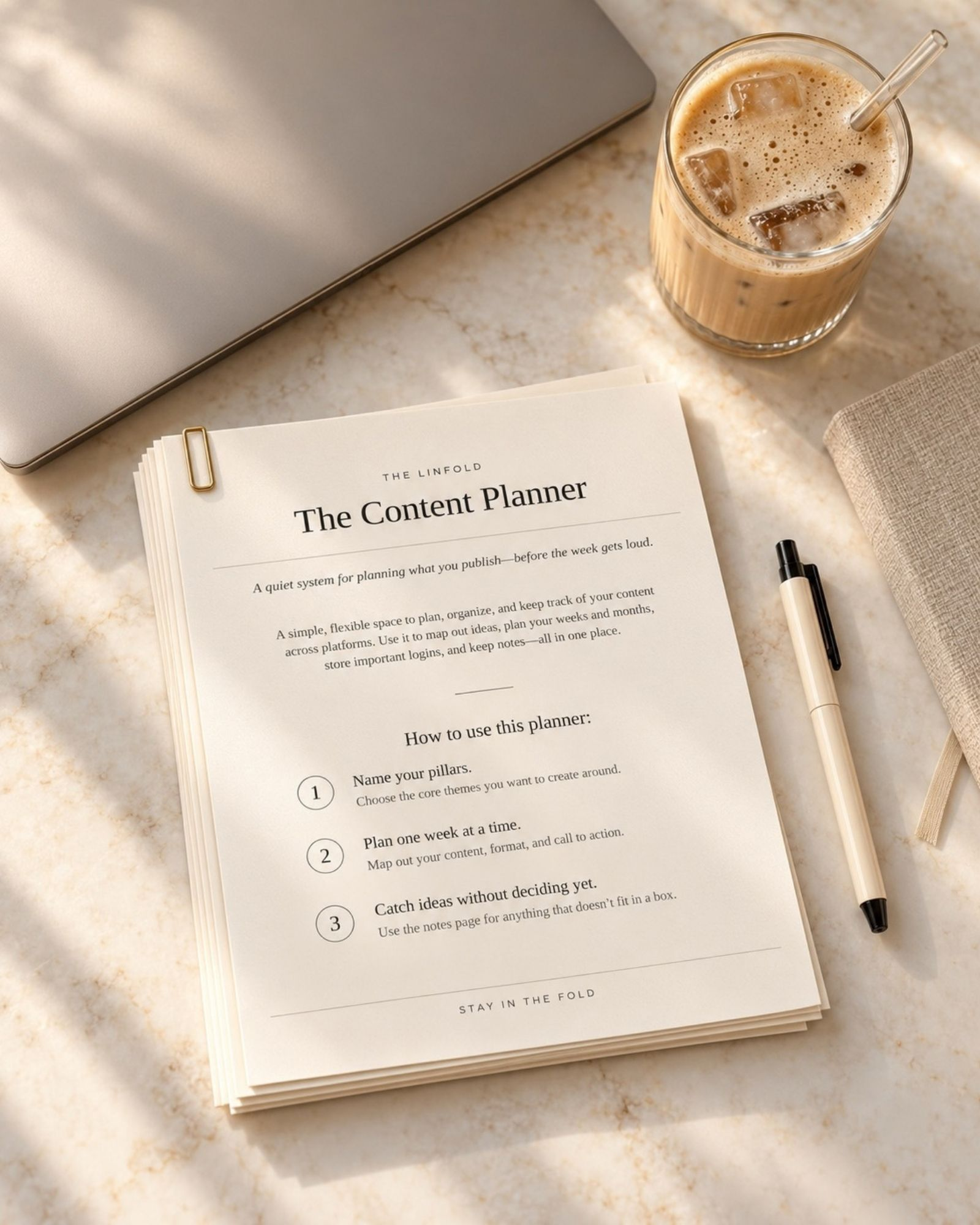
For a fuller look at shaping a week around children and household rhythms, read Plan a Work Week Around Family Life. If it helps to see your focus for the week on one page alongside an idea bank, The Content Planner offers a Weekly Focus page for exactly that.
Consistency, in the end, is a series of small agreements with yourself: a pace you can keep, themes you return to, work grouped sensibly, a plan for hard weeks and time that is protected. Build one at a time, and showing up starts to feel like routine rather than effort.
Your consistency checklist
- Set your pace by your hardest month
- Name three or four content pillars
- Plan two to four weeks in one sitting
- Batch writing, visuals and scheduling separately
- Create templates for formats you repeat
- Define your minimum viable week
- Keep a short list of past pieces to repurpose
- Protect one reliable window for creative work
Keep reading